Click2Print® prepares customised certificates for schools, universities, training institutes, offices, seminars, events, awards and employee-recognition programmes. A useful quotation starts with the certificate category, finished size, quantity, paper, colour coverage, finishing, variable data, approved artwork, required date and delivery destination.
Plan a certificate that is practical to issue, verify and present
Certificate printing is not one fixed product. Academic records, course completions, awards, event participation and corporate recognition can need different paper, security details, personalisation and approval controls. The team reviews the complete specification before confirming price or production timing; submitting an enquiry does not reserve a schedule or create an accepted order.
Certificate categories and intended use
Academic degree, diploma, training, workshop, participation, achievement, appreciation, membership, event and employee-recognition certificates can be reviewed. State who issues the document, how it will be presented or stored, whether it is ceremonial or administrative, and whether every copy is identical. This context helps determine stock, print process, finishing, personalisation and practical handling requirements without implying that a decorative certificate provides legal accreditation.
Finished size, orientation and layout
A4 portrait and landscape are common starting points, but custom finished sizes can be discussed. Confirm width, height, orientation, safe margins and whether a frame, folder, envelope or display mount will be used. Logos, headings, signatures, seals, dates and recipient names need sufficient space and readable contrast. Supply the final dimensions before artwork approval because resizing a finished layout can change line breaks, border positions and finishing registration.
Paper, card and surface choice
Paper weight alone does not define the result. Shade, opacity, stiffness, surface texture, coating and compatibility with signatures, stamps or seals also matter. Smooth white stocks can support crisp detail; warmer, textured or specialty stocks may suit ceremonial presentation but can alter colour and fine type. Share a physical reference or ask whether a material sample is practical when the feel or shade is important. Availability is confirmed with the written quotation.
Colour, logos and brand consistency
Provide approved logos and brand colours in suitable files. Printed colour can differ from a phone or monitor because screens use RGB light while production uses inks or toner on physical stock. Paper shade, coating and print process also affect the result. Critical institutional colours should be identified before proofing, and small text or fine reversed lines should be checked at final size. British spelling, names, titles and dates remain the client’s approval responsibility.
Foil, embossing and premium finishing
Gold or silver foil, embossing, raised details, decorative borders and other finishes may be available when the artwork, stock, quantity and production method are suitable. These processes require clear separation between printed and finished elements and may involve additional setup. Fine details can fill in or lose definition, so the artwork must be assessed before a finish is promised. Feasibility, minimum quantity, cost and effect on production timing are confirmed only in the written quotation.
Variable names, numbering and data control
Recipient names, course titles, grades, dates, serial numbers, QR codes or other fields can vary between certificates. Supply one approved design plus a structured spreadsheet with one record per certificate and clearly named columns. Remove duplicate rows, unwanted spaces and unapproved abbreviations before submission. Click2Print can review the data format, but the issuing organisation must approve spelling, sequence and final content. A controlled sample or proof is recommended before the complete variable run is produced.
Confidentiality and authorised access
Tell the team before sending confidential student, employee or membership data. Share only information needed for the job and confirm any access, non-disclosure, retention or deletion requirement in writing. The secure enquiry form accepts relevant artwork through private storage with generated filenames and expiring authorised links; it must not be used for passwords, identity documents, banking credentials or unrelated personal records. Website enquiry files are covered by the published retention and deletion policy.
Artwork, proofing and production approval
A print-ready PDF at the confirmed finished size is preferred, with suitable bleed where required, embedded or outlined fonts, sharp logos and correctly positioned variable-data fields. Keep important content inside a safe area and remove hidden layers or obsolete versions. Proofread every fixed word and check a representative variable record. A digital or physical proof may be arranged where appropriate, but its availability, cost and effect on timing must be confirmed. Production begins only after the applicable specification, artwork, proof and payment approvals are recorded.
Service methodology
Certificate Printing: specifications and production guidance
Order custom certificate printing for schools, universities, offices, events, training programs and corporate recognition in Lahore.
Suitable uses and requirements
custom certificate printing
training certificate printing
foil certificate printing
A4 certificate printing
Available sizes and measurements
Provide the finished dimensions, orientation, presentation format and personalization fields. Frames, folders, plaques or display components require their own measurements.
Materials or deliverables
Specify the required paper, board, folder or award substrate after reviewing the intended handling and presentation. Unlisted materials are not implied.
Printing technology or workflow
The production route is selected from the item, substrate, quantity, personalization and finish. Variable recipient data must be supplied and approved in an agreed format.
Finishing options
Foil, embossing, lamination, mounting, framing, engraving or other treatments apply only where the service and selected material support them.
File requirements
Supply the final approved file at the intended dimensions. A print-ready PDF is generally preferred; editable AI, CDR, PSD, EPS, SVG or suitable raster files may be reviewed by arrangement. Check spelling, names, dates, page order, codes and contact details before approval.
DPI and resolution guidance
For close-view raster artwork, 300 ppi at final size is a common target. Large-format work may use a lower effective resolution after scale and viewing-distance review. Changing only the resolution metadata does not add image detail.
CMYK and RGB guidance
CMYK is generally preferred for print artwork. RGB artwork may change during conversion. Identify spot colours and critical brand-colour requirements before proofing; screen appearance is not a guaranteed printed colour match.
Bleed and safe area
Bleed and safe-area requirements depend on the product, trim, fold, binding and production method. Confirm the required amount before export and keep essential text and logos away from trim, fold and binding edges.
Quantity considerations
State total items, number of designs and variable names or award categories. Personalization and individual packing can change preparation and unit cost.
Production notes
Approve every recipient name, title, date, serial number, signature position and institutional wording. Click2Print does not validate the legal or academic authority of client-supplied certificate content.
Pricing methodology
Pricing is based on the complete specification, including dimensions, quantity, versions, material, print coverage, production method, finishing, artwork condition, packing, delivery, installation where relevant and applicable tax. A calculator result is a planning estimate unless a written quotation confirms it.
Delivery information
Pickup or delivery scope is confirmed per order. Suitable orders may be coordinated from Lahore for delivery across Pakistan, subject to product suitability, packing, courier availability, destination, charges and schedule. International shipping is reviewed separately and is not guaranteed.
Quality-control checkpoints
Record the approved dimensions, quantity, material, finishing and delivery scope.
Confirm names, numbers, dates, page order, barcodes, QR codes and variable data.
Use a digital or physical proof where the job and agreed workflow require one.
Produce from the approved specification and record material changes before continuing.
Inspect agreed finishing, count, packing and handover details before dispatch or collection.
Service questions
What details are needed for a Certificate Printing quotation?
Share the intended use, finished dimensions or deliverable scope, quantity or number of versions, material, finishing, artwork status, required date and pickup or delivery destination. Click2Print® will confirm applicable options in writing.
Does the displayed information guarantee the final price?
No. A web estimate or general price indication is not a final offer. The written quotation should confirm the complete specification, delivery scope, tax treatment and validity before production.
How is timing confirmed for Certificate Printing?
Timing depends on artwork readiness, material availability, quantity, production method, finishing, proof approval, packing and delivery. A deadline is accepted only when it is confirmed for the specific order.
Certificate specification and quotation checklist
Use this table to prepare one complete enquiry. Prices are not published as fixed offers because paper availability, quantity, variable data, finishing, artwork condition, packing and delivery can change the production route.
Decision
Information to provide
Why it affects the quotation
Purpose and category
Academic, training, participation, appreciation, award or another approved use
Purpose influences paper, finishing, data handling and presentation.
Size and quantity
Finished width and height, orientation, total copies and number of variable versions
Sheet use, setup, finishing and data preparation depend on these values.
Paper and print
Preferred stock, weight, shade, print sides and colour requirements
Material and print method affect appearance, handling and cost.
Finishing
Foil, embossing, numbering, seals, folders, envelopes or none
Special processes need artwork review, setup and production time.
Data and artwork
Approved PDF, logo files, signature method and checked spreadsheet where names vary
Complete, approved files reduce corrections and reprints.
Handover
Required date, pickup or delivery, destination and packing needs
Timing and logistics are confirmed only after the complete job is reviewed.
Certificate production examples
These images are format references. They do not authorise reuse of a client’s name, seal, signatures or confidential data, and the final specification must be quoted separately.
Workshop participation format
Landscape certificate layout with a clear issuer hierarchy, recipient area and signature zone. Material, size, quantity and variable-data handling remain subject to review.
Corporate training format
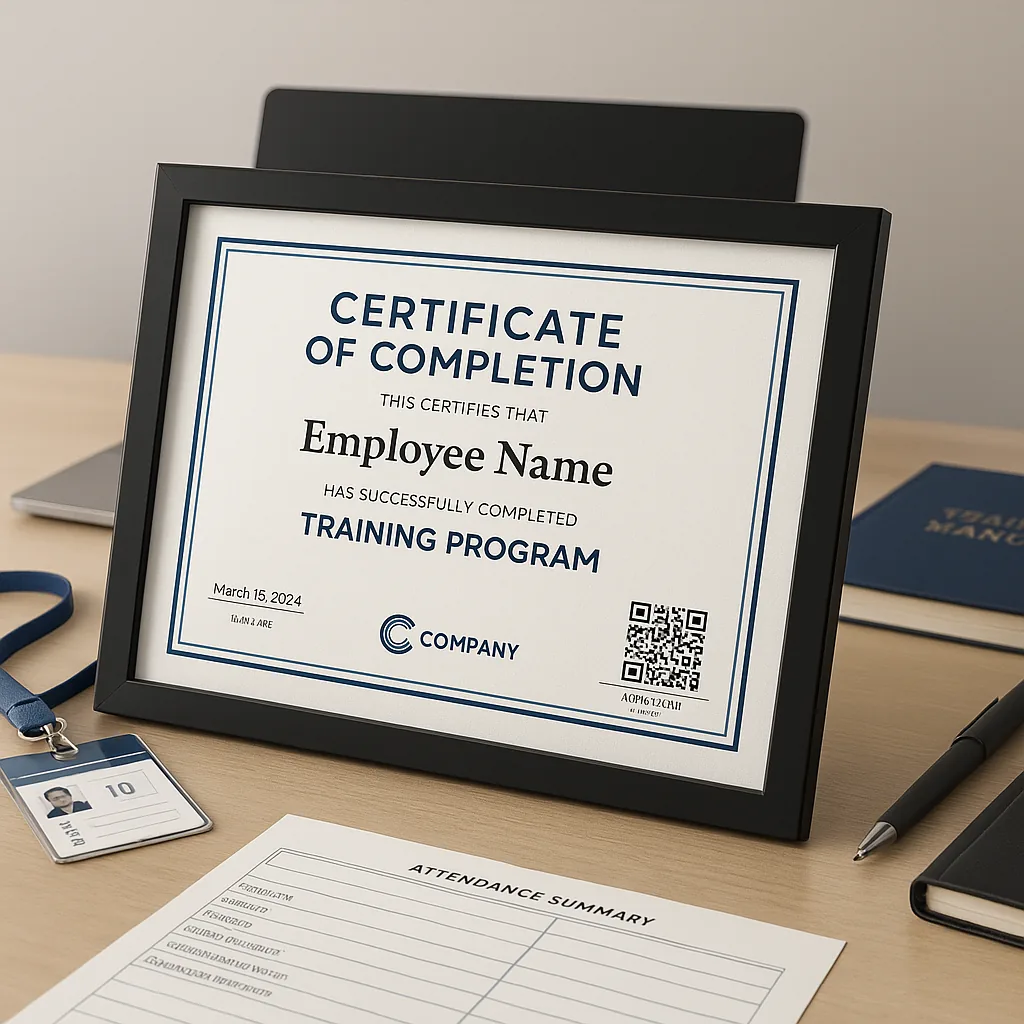
Recognition-oriented presentation suitable for a controlled employee or training list after the organisation approves names, titles, dates and branding.
Skills programme format
A structured certificate reference for course or skills completion. Accreditation, issuer authority and recipient data remain the issuing organisation’s responsibility.
Direct answers before you place an order
Which certificate sizes and quantities can be requested?
Standard and custom finished sizes can be discussed, and both short and bulk requirements can be reviewed. Provide the exact width, height, orientation and total quantity rather than relying only on a name such as A4. If names or serial numbers vary, also state the number of unique records. Feasibility, economical production method, minimum quantity and material availability are confirmed after the complete specification is reviewed.
Can certificates include foil, embossing, numbering or a seal?
These options may be available for suitable artwork, stock and quantities. Each needs enough clear space and artwork prepared for the selected process. A foil or embossing area that is too fine may not reproduce reliably, and numbering or seals can require extra data or handling controls. The team must assess the file before confirming feasibility, setup cost, minimum quantity or production time.
Can every certificate contain a different name or number?
Variable names, dates, course titles and serial numbers can be reviewed when the issuer supplies a clean, approved spreadsheet that matches one approved design. Use one row per certificate, avoid merged cells and clearly label every column. The issuing organisation remains responsible for spelling, titles, sequence and authority. A representative proof should be approved before the full run where the data is important.
What files are needed for certificate printing?
Provide a print-ready PDF at the confirmed finished size plus any required bleed, sharp logo files and a checked spreadsheet for variable data. Fonts should be embedded or outlined where appropriate. If Click2Print is asked to prepare or correct the design, provide the approved wording, logos, signature method and reference material. Design scope, revisions and fees are confirmed separately from printing.
How are confidential certificate files handled?
Use the secure certificate enquiry form and upload only the artwork or data needed for review. Files are stored outside the public website with generated names and expiring authorised links under the published retention policy. Tell the team about any shorter deletion period, access restriction or non-disclosure requirement before uploading. Do not submit identity documents, passwords, banking information or data you are not authorised to share.
How quickly can certificates be produced?
No universal turnaround is guaranteed. Timing depends on the approved artwork, variable-data condition, quantity, paper availability, finishing, proof method, payment confirmation, current production schedule, packing and delivery destination. Share the required date at the start; the team will confirm whether it is feasible only after reviewing the complete job. Courier estimates are separate from production timing and can change.